Value-based Care
Seven Critical Questions ACO Leaders Must Ask to Drive Success

Seven Critical Questions ACO Leaders Must Ask to Drive Success
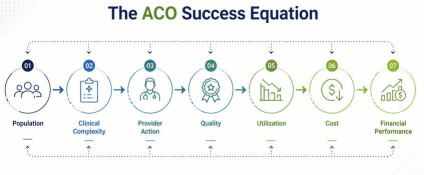
ACO success is not simply about reducing costs or achieving quality targets. It comes from understanding how your population, providers, clinical complexity, quality, utilization, and financial strategy work together.
Use these seven questions to drive your operational strategy regardless of whether you are a new entrant or transitioning into the ACO LEAD model.
1. Do we actually understand our population?
Most ACO leaders can tell you how many beneficiaries are attributed to their organization but that is not the same as understanding the population. A population should never be viewed as one homogeneous group.
1. Do we know who is attributed to us and do we understand the population beyond the attributed lives count?
2. Who are our high-risk and rising-risk patients, and can we identify them early enough to intervene?
3. Where are our patients receiving care, including care outside our network? 4. Which conditions and patient populations are driving the greatest clinical needs and costs?
5. Where are the most significant care gaps, access barriers, and unmet needs? 6. Who is driving avoidable ED visits, admissions, readmissions, and other high-cost utilization and why?
Each population requires a different strategy. This is where population segmentation becomes critical.
The goal is to move from counting patients to understanding patients and then to segmenting the population so that resources can be directed where they can have the greatest impact.
2. Is clinical complexity being accurately represented?
If the medical record does not accurately reflect the patient's disease burden, the organization will make clinical and financial decisions using an incomplete picture.
Here are the key questions to ask:
1. Does our data accurately reflect the true clinical complexity of our population? 2. Are chronic conditions being assessed and documented consistently year over year?
3. Where are our largest documentation and risk-capture gaps?
4. Are providers receiving useful documentation guidance at the point of care? 5. Are we identifying discrepancies between claims, clinical data, and the medical record?
6. Are our risk-adjustment processes accurate, compliant, and integrated into clinical workflows?
Accurate documentation and risk adjustment are therefore much more than coding activities. They influence population stratification, resource allocation, financial performance, and the organization's understanding of the population it has agreed to manage.
The objective is for the data to tell the full story about the patient.
3. Can we identify avoidable utilization early?
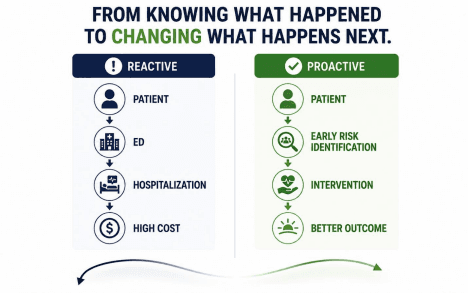
Knowing utilization was high after the performance period is analysis but strategy is in the identification of the patient most likely to become high-cost while there is still time to intervene.
Here are the key questions to ask:
1. Do we know which patients are driving potentially avoidable ED visits, admissions, and readmissions?
2. Can we identify rising-risk patients before they become high-cost? 3. Do we understand the clinical, behavioral, and social drivers behind repeated utilization?
4. How quickly do hospitalization and ED data reach the teams responsible for intervention?
5. Are high-risk patients consistently connected to care management and timely follow-up?
6. Can we demonstrate that our interventions are actually reducing avoidable utilization?
Acos need to identify patterns behind avoidable ED visits, hospitalizations, readmissions, post-acute utilization, and other cost drivers and connect those insights to care management and clinical intervention.
The moves your thinking to the more valuable action of predicting and preventing unwanted outcomes
4. Are providers receiving actionable information?
More data does not automatically create better decisions.
A 40-page dashboard is not necessarily actionable intelligence. Providers need timely, prioritized information that allows them know what to do for the patient at the point-of care.
Here are the key questions to ask:
1. Are providers getting the right information before or during the patient encounter? 2. Can they quickly see the most important care gaps, risk opportunities, and recent utilization?
3. Is information integrated into existing workflows, or are we creating additional administrative work?
4. Are we prioritizing what providers need to act on rather than overwhelming them with data?
5. Do providers understand what action is expected from the information we send them?
6. Are we measuring whether provider-facing information actually changes behavior and outcomes?
Care gaps, recent hospitalizations, documentation opportunities, medication concerns, and other important information should reach providers as close to their normal workflow as possible.
If data does not ultimately lead to action, it is just information.
5. Are quality, risk adjustment, and utilization working together?
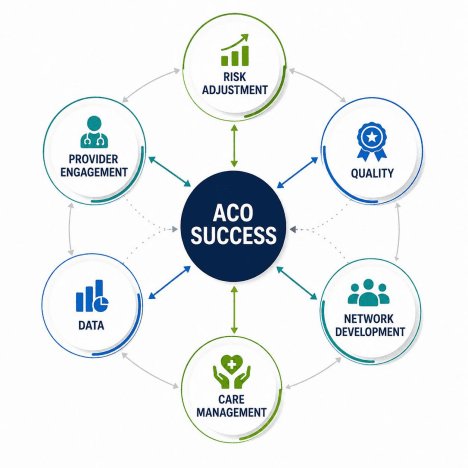
Healthcare organizations often manage quality, risk adjustment, utilization, care management, and provider engagement as separate functions.
The patient does not experience them separately and neither does the financial model. Here are the key questions to ask:
1. Are quality, risk adjustment, utilization, care management, and provider engagement working from the same population strategy?
2. Can teams see when the same patient has quality gaps, documentation opportunities, and utilization risk?
3. Are we coordinating provider outreach across functions or sending multiple competing requests?
4. Do our data systems create a shared view of patient and provider performance? 5. Are functional leaders jointly accountable for outcomes that cross departmental boundaries?
6. Are we measuring the combined impact of our interventions on quality, risk, utilization, and cost?
The same patient may have a quality gap, incomplete documentation, increasing utilization, and a need for care management.
Successful ACOs connect these functions around one patient, one provider, and one strategy.
6. Do we understand the economics beneath the benchmark?
Shared savings is not simply "spend less and make money."
Leaders need to understand what is driving the benchmark, how risk adjustment and quality affect performance, where utilization is changing, and which investments can meaningfully influence total cost of care.
Here are the key questions to ask:
1. Do we understand what is actually driving our benchmark and financial opportunity?
2. Which populations, conditions, sites of care, and services are driving our total cost of care?
3. How are risk adjustment and quality performance affecting our financial results? 4. Where are we outperforming the benchmark—and where are we losing ground? 5. Do we know the expected clinical and financial return from our major VBC investments?
6. Can we distinguish between improving a performance metric and actually creating economic value?
Sometimes spending more on primary care, care management, transitions of care, or other upstream interventions can prevent much more expensive downstream utilization.
The thinking should shift from moving the metric to improving the economics. 7. Have we aligned incentives with the behaviors we need?
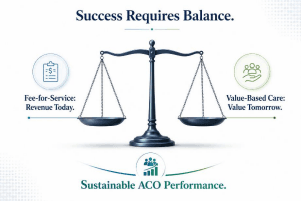
This is particularly important while fee-for-service and value-based care continue to coexist.
Under FFS, additional services can generate additional revenue. Under value-based care, unnecessary utilization can erode financial performance.
Organizations cannot ask providers to think in value while every meaningful incentive continues to reward volume.
1. Are our financial incentives aligned with the outcomes we expect providers to deliver?
2. Are we still rewarding volume while asking providers to manage cost and utilization? 3. Do providers understand how their individual actions affect ACO performance? 4. Are quality, appropriate utilization, documentation, care coordination, and patient outcomes meaningfully reflected in incentives?
5. Are shared-savings and performance incentives structured so providers can see a clear connection between behavior, performance, and reward?
6. Have we given providers the data, workflows, resources, and support they need to succeed under the incentives we have created?
Compensation, shared-savings arrangements, performance measures, resources, and leadership priorities should reinforce the behaviors the organization needs: prevention,
appropriate utilization, quality, coordination, accurate documentation, and better outcomes.
The bottom line
ACO success lies in the ability to connect all areas
Population → Clinical Complexity → Provider Action → Quality → Utilization → Cost → Financial Performance
An ACO can have great analytics, excellent clinicians, strong quality programs, and sophisticated risk-adjustment capabilities and still struggle if those pieces operate in siloes.
Successful ACOs will be the ones that integrate all the levers. ACOS leaders must have interdisciplinary competencies. They must exist as boundary spanners to allow them to integrate all the success levers seamlessly. Summarily, when choosing leaders. ACOs need unicorns.
Food for thought: How many of these seven questions can your organization confidently answer today?