Value-based Care
What ACOs Need to Get Right as We Move Into LEAD

When I first got into the business of healthcare, it had a relatively straightforward economic model.
Provide a service. Document the service. Bill for the service. Get paid.
That model is called fee-for-service (FFS).
Then came the value-based care (VBC) model, with a fundamentally different proposition.
The proposition?
Take responsibility for the population. Improve outcomes. Manage the total cost of care. Share in the value you create.
The industry often talks about these as though healthcare simply moved from one model to the other.
It did not. Most organizations were already operating somewhere in between.
And that is one of the most important challenges facing Accountable Care Organizations today.
The ACO Is Living in Two Economic Worlds
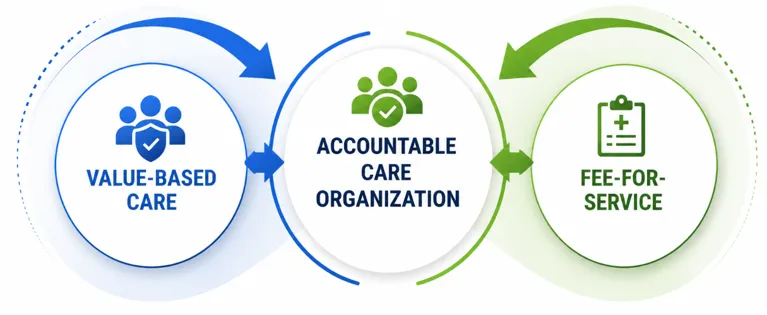
Under fee-for-service, more reimbursable activity generally creates more revenue.
Under value-based care, care quality and patient outcomes are emphasized. Here, unnecessary utilization can destroy value.
That dissonance is where a synchronized operating model and strategy adds benefit.
Let us review a common example.
A hospital admission may generate FFS revenue today, but it conversely increases the ACO's total cost of care.
An avoidable emergency department visit still gets paid, but the expenditure eventually shows up in the population's cost.
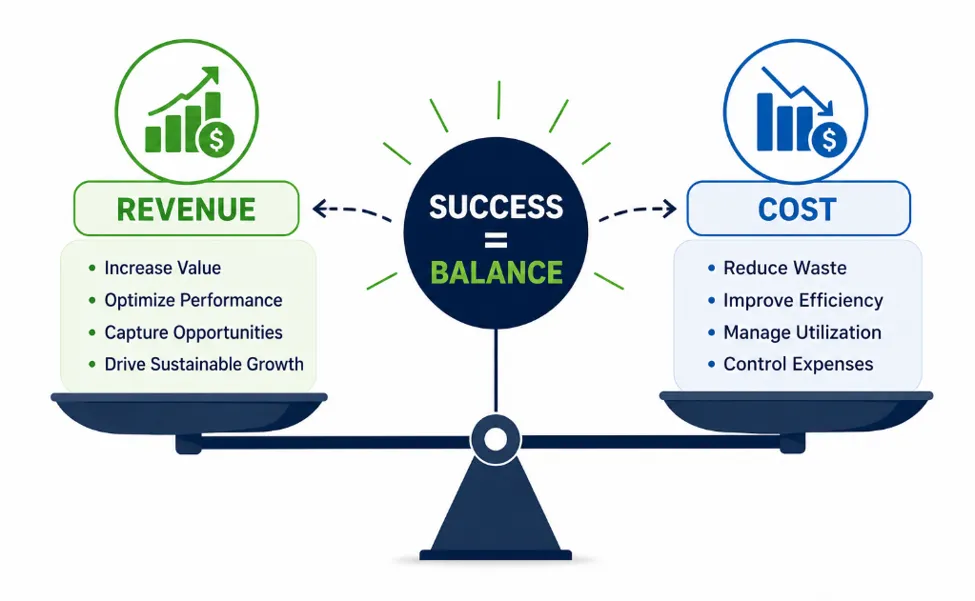
That means an organization can appear successful through one financial lens while quietly underperforming through another.
This is why succeeding in an ACO requires more than adding a "value-based care department" to a fundamentally fee-for-service organization.
The operating model itself must change, and this only happens when the organization understands what drives balance.
Welcome to the Next Chapter: LEAD - Long-term Enhanced ACO Design
Here is why we need to have this conversation.
ACO REACH concludes at the end of 2026, and CMS's Long-term Enhanced ACO Design – the LEAD model begins on January 1, 2027.
LEAD is not simply a new acronym in our cache of acronyms. It is another step in the evolution of accountable care.
LEAD has a 10-year performance period and introduces new approaches to benchmarking, risk adjustment, population-based payment and specialty integration intended to make accountable care more sustainable for a broader range of organizations, especially new entrants and smaller, rural-based organizations.
Each type of organization requires a different approach to succeed. For experienced REACH organizations, the challenge is how to transition smoothly. For newcomers, the challenge lies in how to transform from a volume-based to a value-based strategy. Success therefore requires much more than understanding the rules of the LEAD model.
It requires tailoring your strategies to your organization's maturity.
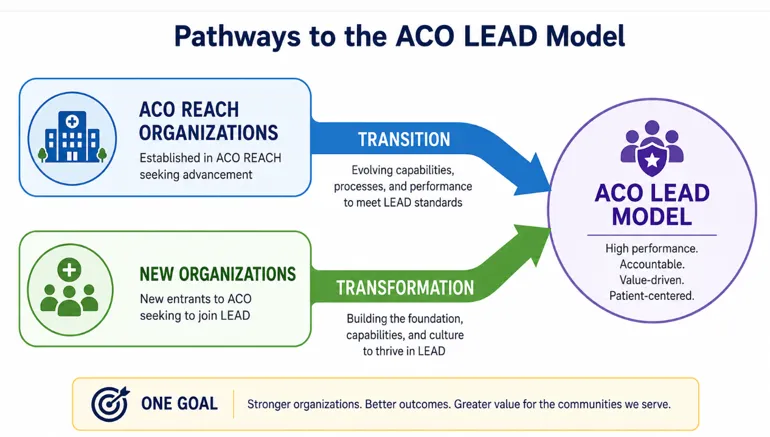
Organizations transitioning from ACO REACH have an advantage as they already have infrastructure, experience managing populations and familiarity with downside risk.
Newcomers need to understand how documentation and risk adjustment affect how accurately the clinical complexity of that population represents. They must understand the interplay of quality, network configuration, care management, data, and provider engagement.
No aspect of this can afford to be neglected.
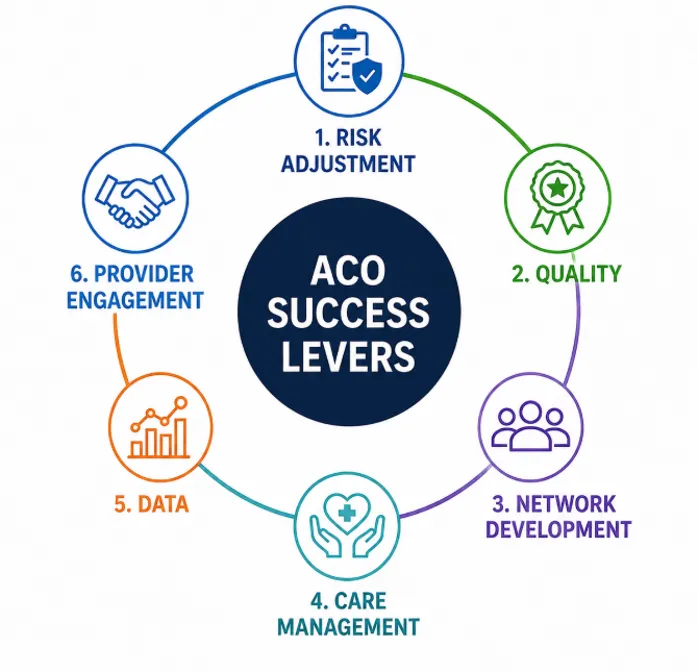
None of these functions can operate successfully as isolated projects.
Organizations therefore need the right strategy and must build their internal weighted models to identify how much attention, staffing, and resources each area needs.
In my next article, I will share with you the seven key questions any ACO leader needs to ask before stepping out of the door.